Roller Shades: Minimalist and Endlessly Versatile
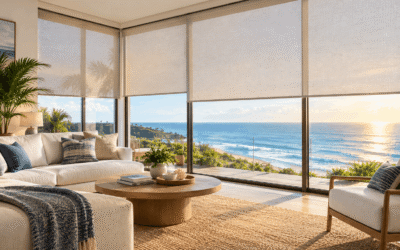
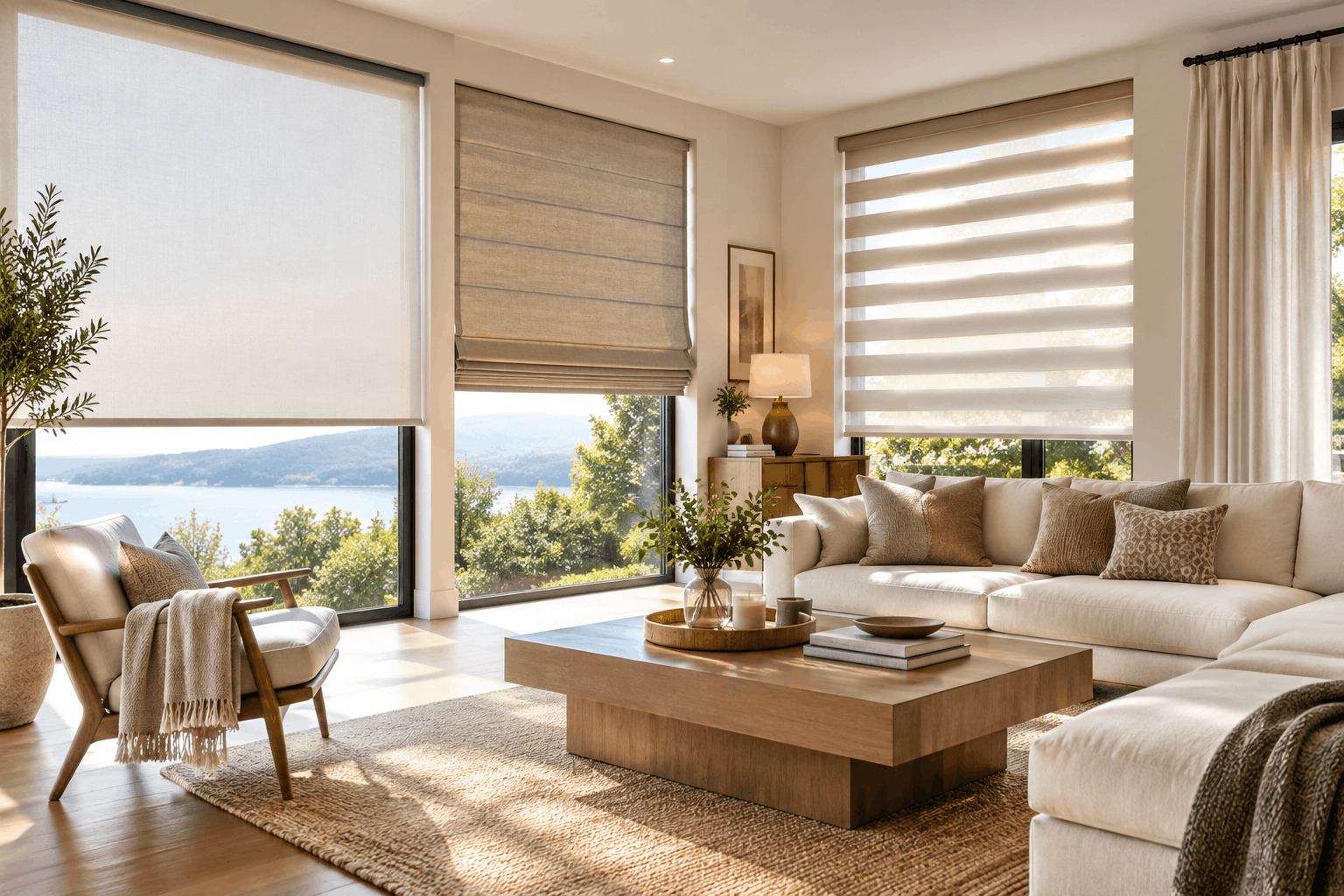
Roller shades remain one of the most consistently popular choices for modern homes, and their appeal comes down to simplicity. A single flat panel of fabric, operated with a clean, unobtrusive mechanism, gives a room a streamlined look that works with almost any interior style, from a coastal-casual living room to a sleek, contemporary office.
What keeps roller shades trending isn’t just the minimalist profile, it’s the range of fabric options now available. Light-filtering, blackout, and solar fabrics all come in a roller format, which means the same clean silhouette can be adapted to nearly any room’s function. Textured and patterned roller fabrics have also become more common, giving homeowners a way to add visual interest without moving away from the style’s fundamentally simple structure.
Cellular (Honeycomb) Shades: Function Driving the Trend
Cellular shades continue to gain popularity, and unlike some purely aesthetic trends, this one is driven largely by performance. Their honeycomb structure traps insulating air pockets that reduce heat transfer through the window, which has made them an increasingly popular choice as homeowners pay closer attention to energy costs and comfort.
Beyond energy efficiency, cellular shades with side channels have become a standout option for bedrooms specifically, since the channels close the narrow light gaps that appear around standard inside-mount shades, delivering a noticeably darker room than an unchanneled installation. Cellular shades also help dampen outside noise, adding another practical benefit that keeps them relevant well beyond their original reputation as simply an efficient option.
Woven Wood and Bamboo Shades: The Natural Materials Movement
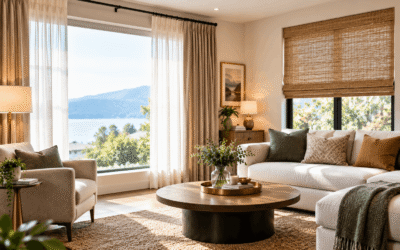
Few trends have grown as consistently as the shift toward natural, textured materials, and woven wood shades sit right at the center of it. Handwoven from bamboo, jute, reed, and grasses, these shades bring an organic warmth that pairs naturally with the broader biophilic design movement, which emphasizes bringing natural materials and textures into interior spaces.
What’s changed recently is the refinement of the weaves themselves. Finer, more detailed weave patterns have become more popular, giving woven wood a more tailored, sophisticated look rather than the heavier, more rustic appearance the style was originally known for. This makes woven wood shades a strong fit for modern homes that want organic texture without sacrificing a clean, intentional aesthetic. They’re commonly paired with sheer panels or drapery for added flexibility, letting a room shift between soft, filtered daylight and full privacy or blackout when needed.
Roman Shades: Elegant Structure Making a Comeback
Roman shades have held steady as a favorite for homeowners who want more visual structure than a flat roller shade provides, and linen has become a particularly popular fabric choice for this style in modern interiors. Linen’s natural texture brings a relaxed, elevated look that suits both classic and more casual modern homes, though it’s worth knowing that as a natural fiber, linen shades can stretch slightly over time.
Available in flat, pleated, and more tailored fold styles, Roman shades offer a level of visual craftsmanship that few other shade styles can match, which is why they continue to show up in higher-end interior design even as more minimalist styles dominate elsewhere in the home.
Solar Shades: Function-First, But Increasingly Stylish
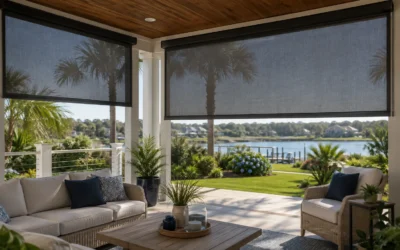
Solar shades have moved from a purely practical choice to a genuine design option in their own right. Originally valued almost entirely for UV and heat protection, solar shade fabrics are now available in enough colors, weaves, and openness levels that homeowners can choose a look that fits the room’s design rather than settling for a purely functional appearance.
This shift matters most in rooms with a view worth preserving, living rooms facing the water, sunrooms, or any space where blocking the window entirely isn’t the goal. Solar shades let homeowners maintain that connection to the outdoors while still cutting glare and UV exposure, which is exactly the kind of dual-purpose design modern homeowners are gravitating toward across nearly every category of shade right now.
Zebra and Dual Shades: Light Control as a Design Feature
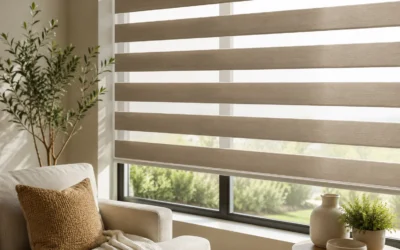
Zebra shades, sometimes called dual or banded shades, have become one of the more visible newer trends, largely because they solve a problem elegantly rather than through a compromise. Alternating sheer and opaque bands let a single shade shift continuously between soft, filtered light and full privacy, which appeals directly to how modern homeowners actually use their spaces throughout the day.
Beyond function, the banded pattern itself has become a design element on its own, with tonal pairings offering a subtle textural look and higher-contrast pairings creating a bolder, more graphic statement. This dual role, genuinely useful and genuinely stylish, is a big part of why zebra shades have moved from a niche product to a mainstream favorite in a relatively short time.
Layered Shades: Two Treatments Working Together
One of the most visible trends in modern homes right now isn’t a single shade style at all, it’s the growing popularity of layering two treatments together. Pairing an inner shade, typically roller or cellular, with an outer layer of drapery has become a defining look in modern interiors, and it’s popular for a genuinely practical reason as much as a visual one.
Functionally, each layer handles a different job. The inner shade manages daily light control and privacy, while the outer drapery adds softness, a finished look, and additional insulation or blackout when fully closed. Visually, the combination creates a layered, designer-level depth that a single flat shade on its own simply can’t achieve. Motorized versions of this setup, with both the shade and the drapery automated, have also become increasingly accessible as motorization technology has dropped in price, making a fully automated layered window into a realistic option for far more homeowners than it was even a few years ago.
Color and Texture: Where Modern Design Is Heading
Alongside the shift in styles, color trends have moved firmly toward earth tones and warm neutrals, beige, warm taupe, clay, cream, and muted greens showing up across nearly every shade category. This reflects a broader move toward a quieter, more tailored look in modern interiors, where texture does more of the visual work than bold pattern or color.
Textured solids, in particular, have become a defining choice across multiple shade styles at once, appearing in roller shades, Roman shades, solar shades, and drapery alike. Choosing a textured neutral fabric adds depth and tactile interest to a room without relying on pattern, which keeps the look from feeling dated the way a bold, trend-specific color or print sometimes does within just a few years. For homeowners who want to experiment with a bolder look without full commitment, smaller or less prominent windows are a lower-risk place to try a statement color or a more heavily textured woven wood, saving the safer, more neutral choice for the windows that anchor the main living spaces.
Motorization: No Longer a Luxury-Only Feature
It’s difficult to talk about modern shade trends without addressing motorization directly, since it’s reshaping how nearly every style on this list gets used day to day. What was once a high-end, luxury-only feature has become increasingly accessible as battery technology, smart home integration, and manufacturing costs have all improved. Motorized versions now exist across almost every shade category on this list, roller, cellular, Roman, woven wood, and zebra shades included, giving homeowners scheduling, remote control, and smart home compatibility regardless of which style they choose.
This matters for modern homes specifically because automation and design increasingly move in tandem rather than in competition. A motorized cellular shade in a clean, neutral fabric delivers both the tailored, minimalist look modern homeowners want and the convenience of a fully automated home, without one coming at the expense of the other.
Choosing the Right Style for a Modern Coastal Home
Not every popular style suits every home equally, and this is where a coastal setting adds its own set of considerations on top of general design trends. Solar and cellular shades tend to perform best against Gulf sun and heat, woven wood brings organic texture but needs the right material and liner to handle humidity well, and roller shades offer the flexibility to fit almost any room without a heavy commitment to one aesthetic. Layering, meanwhile, gives homeowners a way to combine the practical performance a coastal home genuinely needs with the softer, more finished look that makes a room feel complete.
The right combination ultimately comes down to how each room is used and how much sun, humidity, and privacy exposure it deals with day to day, which is exactly the kind of room-by-room assessment a proper consultation is built for.