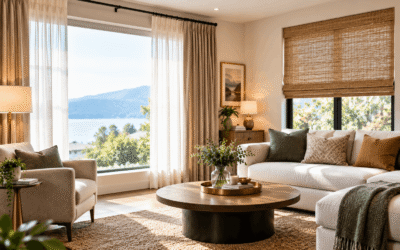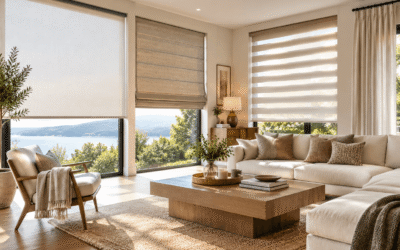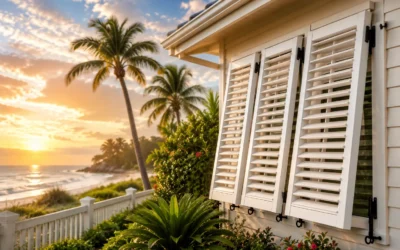
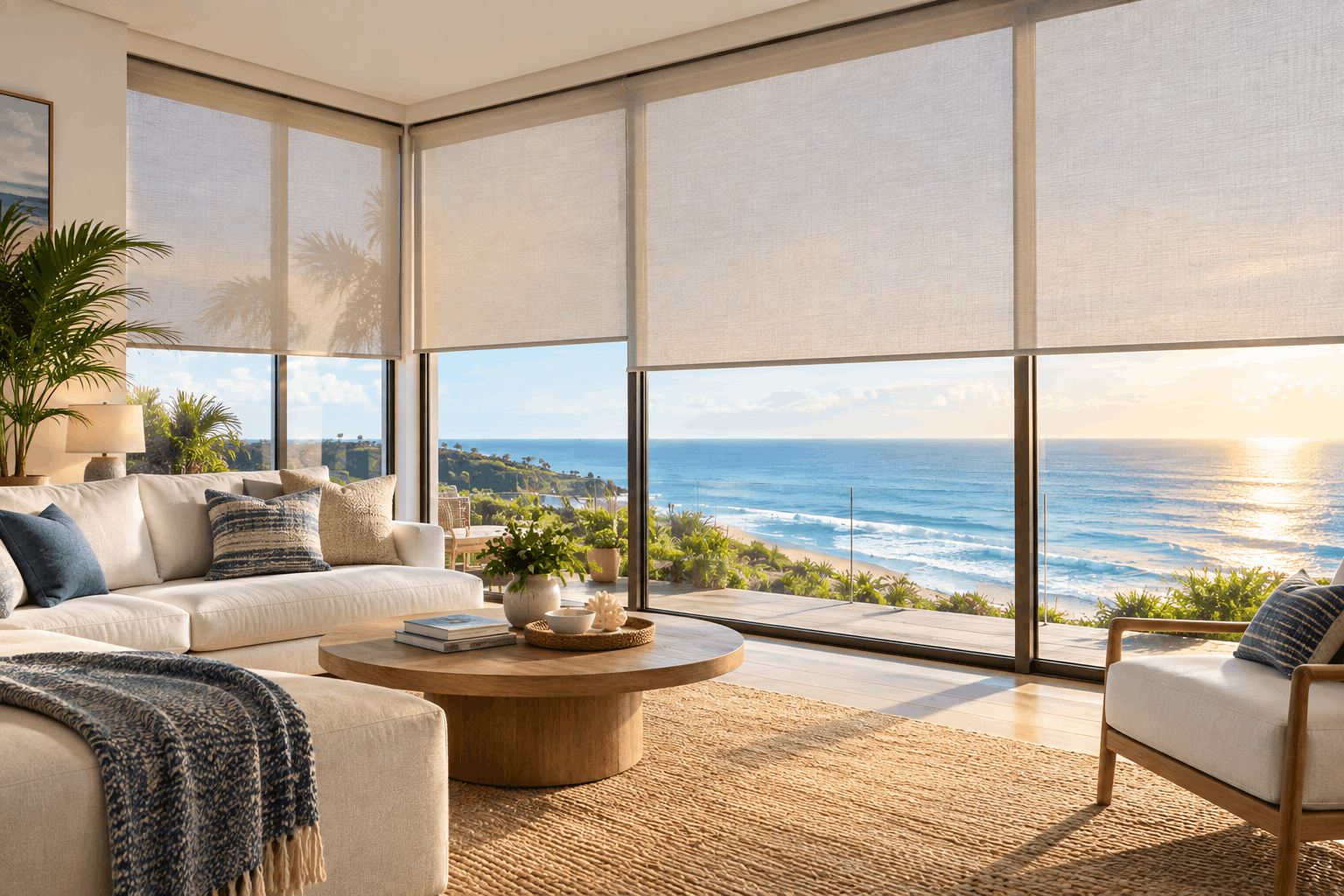
Here’s how to approach that decision for a living room built around a water view.
The Core Challenge: Protection Without Sacrifice
Most rooms in a house are designed with a mix of priorities, some light, some privacy, some style. An ocean-view living room really only has one non-negotiable: preserve the view. Everything else, heat control, glare reduction, UV protection, evening privacy, has to be solved around that constraint rather than at its expense.
This is exactly the problem solar shades were built to address, and it’s why they’re consistently the starting point for this specific type of room, though they’re rarely the whole answer on their own.
Solar Shades and the Openness Factor Decision
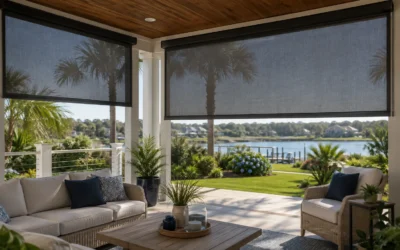
Solar shades work like sunglasses for a window. A tightly woven mesh fabric filters incoming light, cutting glare and blocking a high percentage of UV rays, while still allowing a usable view straight through the fabric.
The single most important decision with a solar shade is its openness factor, the percentage of the weave that’s actually open versus woven. For a living room built around an ocean view specifically, this is where most of the customization happens:
- 1 to 3 percent openness delivers the strongest heat and glare reduction, blocking up to around 99 percent of UV rays, but it noticeably softens the sharpness of the view. This range makes more sense for a media room or a window that gets brutal, direct afternoon sun than for a primary picture window.
- 5 percent openness is the sweet spot most homeowners land on for a genuine ocean view. It still cuts a substantial amount of heat, glare, and UV while keeping the view sharp enough that the room still feels open and connected to the water.
- 7 to 10 percent openness keeps the clearest possible view and the brightest room, with somewhat less heat and glare reduction. This works well for a living room that gets a good but not overwhelming amount of direct sun, or for homeowners who are prioritizing view above all else and are comfortable using other layers (discussed below) to manage the toughest hours of the day.
Fabric color plays a role too. A darker, plain-weave fabric generally gives a clearer, sharper view through the shade than a lighter or patterned one, since less light reflects back at you as you look through it. Lighter fabrics, on the other hand, reflect more heat before it reaches the room, which can matter more on the hottest, most exposed windows.
What This Actually Does to the Room
The performance numbers here are worth knowing, because they explain why solar shades earn their reputation rather than just looking good on paper. In severely sun-exposed rooms, the right solar shade can cut heat gain dramatically and lower room temperature by a noticeable, felt amount, not just a marginal difference. For a Gulf-facing living room that currently turns into a greenhouse by early afternoon, that’s the difference between a room the household avoids during the day and one that’s genuinely comfortable to use.
Solving Glare on the TV
Ocean-view living rooms almost always have a television positioned somewhere in the room, and this creates a specific problem solar shades solve particularly well. A lower openness factor, generally in the 1 to 5 percent range depending on exactly how the sun hits the screen, cuts glare significantly while still allowing enough natural light through to avoid making the room feel closed off.
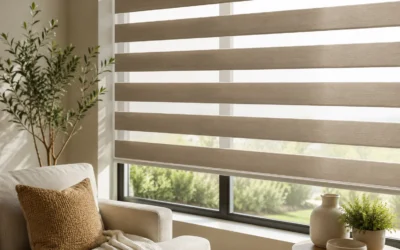
For living rooms that double as a movie or media space, dual shades, which pair a light-filtering layer with a room-darkening layer on the same headrail, offer the most flexibility. Daytime use keeps the view and natural light, while a quick switch to the darker layer creates a proper viewing environment for movie nights without needing a completely separate shade installed.
Managing Evening Privacy Without Losing the View
Daytime privacy is rarely the concern with an ocean-view living room, since most of these homes look out toward water rather than a neighboring property. Evening is a different story. Once interior lights are on and it’s dark outside, an uncovered window turns into a mirror that shows the room’s interior far more than it shows the view, which is worth planning for even in a home that otherwise wants that glass left open all day.
Top-down bottom-up shades are a popular answer here, since they let the top portion of the window stay open for daytime view and light while the bottom portion can be raised for privacy exactly when it’s needed, without sacrificing the view during the hours when privacy isn’t actually a concern. For homeowners who want a simpler single-shade solution, a moderate openness solar shade, closed only in the evening, achieves a similar result with one product rather than two.
Sheer Shadings as an Alternative Approach
Solar shades aren’t the only product built for this kind of room. Sheer shadings, which use soft fabric vanes between two sheer facings, offer another way to manage glare without fully covering the window. Because the vanes tilt rather than requiring the shade to be raised or lowered, they let a homeowner fine-tune glare and light throughout the day with small adjustments rather than an all-or-nothing choice. This style tends to suit living rooms with a more traditional or softer design aesthetic, where the visual texture of a fabric vane fits the room better than the flatter, more minimal look of a mesh solar shade.
Protecting Furniture and Flooring Without Blocking the View
An ocean-view living room usually holds some of the most expensive furniture in the house, the piece chosen specifically to be enjoyed while looking out at the water. That furniture, along with any flooring or rugs in the direct sun path, is also the most exposed to UV damage in the home.
This is one more reason solar shades make sense as the foundation for this room specifically: they’re one of the only window treatments that meaningfully cuts UV exposure while still leaving the window visually open. A homeowner who skips window treatments entirely to preserve an unobstructed view is often protecting the view at the direct expense of everything sitting in front of it.
Motorization for Large or Hard-to-Reach Spans
Ocean-view living rooms frequently come with the largest, tallest, or most architecturally ambitious windows in the house, floor-to-ceiling glass, wide sliding door walls, or windows positioned above a piece of furniture that makes manual operation awkward. Motorized solar shades solve this cleanly, and manufacturers now build shades specifically engineered for extra-wide spans and tall openings, made to the home’s exact dimensions rather than pieced together from standard sizes.
Beyond solving the practical reach problem, motorization also makes daily use of a well-considered shade setup far more likely. A shade that requires wrestling with a wand or cord to operate a nine-foot span tends to get left in one position indefinitely, which defeats the purpose of choosing a flexible openness factor in the first place. A motorized shade that lowers automatically during peak afternoon sun and raises again once the harshest hours pass keeps the room performing the way it was designed to, without requiring anyone to remember to adjust it.
Style Considerations for a View-First Room
Because the window itself is the visual centerpiece of an ocean-view living room, the window treatment should generally support that focal point rather than compete with it. Clean, minimal hardware that rolls fully into a headrail when raised, leaving the window completely clear, tends to suit this kind of room better than a treatment with visible cords, heavy valances, or a busy pattern that draws attention away from the view.
For very wide openings that span an entire wall, vertical panel or gliding track systems are also worth considering alongside a solar shade, particularly for sliding door walls that need a treatment covering the full width without a single oversized shade becoming unwieldy to operate.
Bringing It Together for a Coastal Living Room
The right setup for most ocean-view living rooms ends up being less about choosing a single perfect product and more about layering a small number of well-matched pieces: a solar shade at a moderate openness factor as the daily-use foundation, motorization if the window is large or tall, and either a top-down bottom-up configuration or a simple evening routine to handle privacy once the sun goes down. Media-heavy living rooms benefit from adding a dual shade or a slightly lower openness factor specifically to manage TV glare.
None of this has to mean guessing. A free in-home consultation accounts for the exact direction the room faces, how much direct sun it gets across the day, and how the space actually gets used, whether that’s quiet mornings with coffee and a view or regular movie nights that need real glare control, so the final combination protects the room without ever making you feel like you’re covering up the reason you bought the house in the first place.