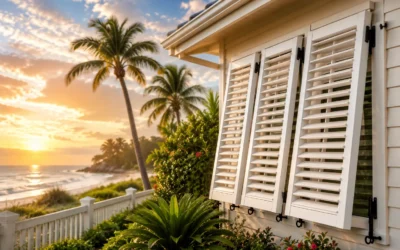
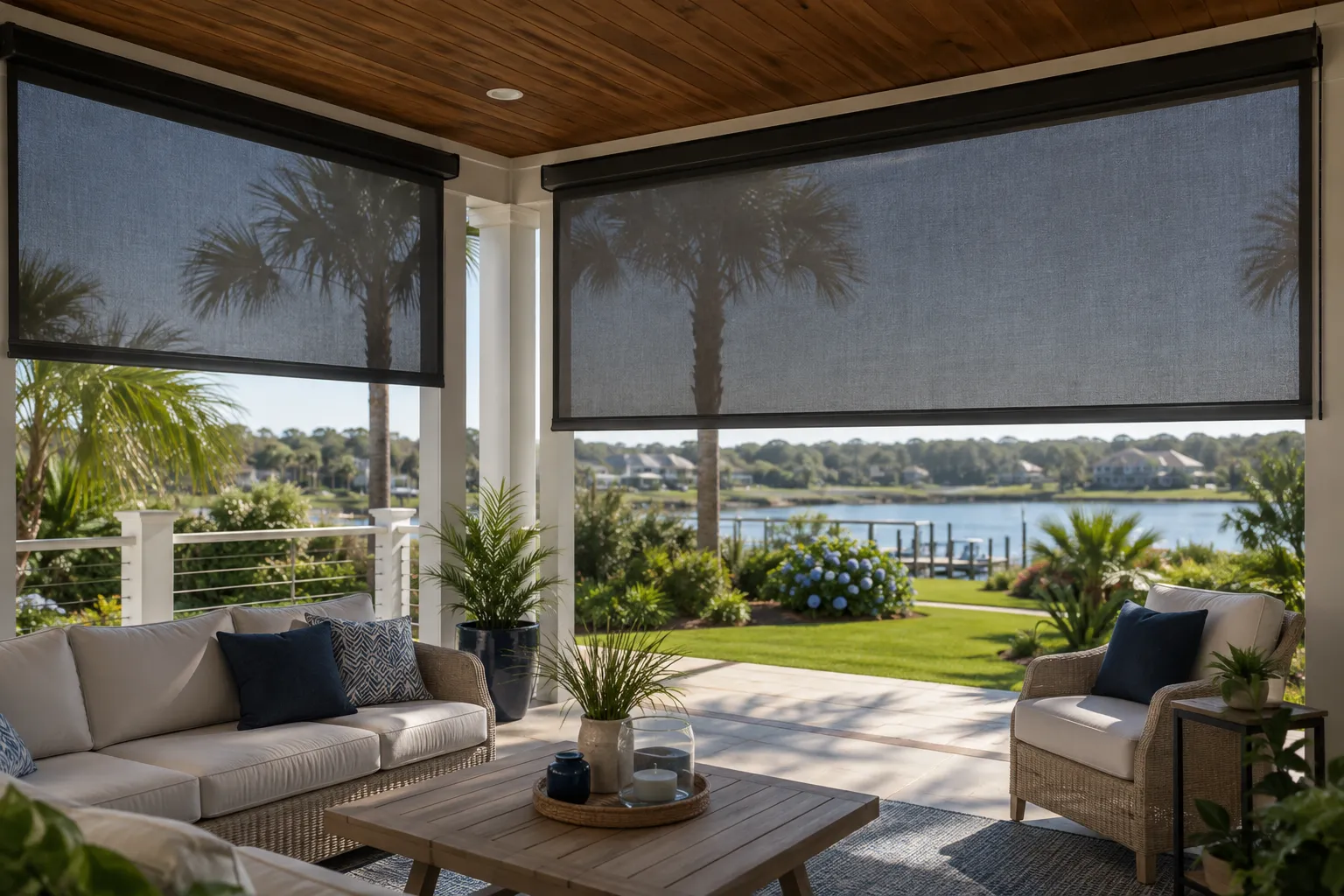
This guide goes deep on how outdoor roller shades work, what separates a shade built to survive Gulf Coast conditions from one that isn’t, and how to think through material, mounting, and motorization choices for your specific outdoor space.
What Makes an Outdoor Roller Shade Different From an Indoor One
It’s tempting to think of an outdoor roller shade as simply an indoor shade installed outside, but the products are built entirely differently, and for good reason. Indoor shade fabrics aren’t engineered to survive direct rain, standing humidity, UV exposure without the buffer of window glass, or the wind loads that come with an open patio or elevated porch.
Outdoor roller shades are built from specialized weather-resistant fabrics designed specifically for these conditions, paired with hardware, brackets, and mounting systems rated for exterior use. The result is a shade meant to live outside permanently, holding up through a full Gulf Coast season of sun, salt air, humidity, and the occasional storm, rather than degrading within a year the way an indoor product forced outdoors typically would.
The Fabric Question: What Outdoor Shades Are Actually Made Of
This is the single most important decision in choosing an outdoor roller shade, since the fabric determines UV protection, durability, airflow, and how the shade performs in wind and rain.
PVC-coated polyester is one of the most common and cost-effective options. Water rolls off the coated surface rather than soaking in, which helps prevent mildew growth in a humid coastal climate, and it’s generally the most budget-friendly of the durable outdoor fabrics.
PVC-coated fiberglass offers excellent weather resistance along with strong UV protection, and fiberglass-core fabrics tend to hold their shape well over time without sagging or stretching, even after repeated exposure to heat and sun.
HDPE (high-density polyethylene) knitted fabric is a tougher, more heavy-duty option that blocks a high percentage of both sun and visibility, making it a strong choice where privacy matters as much as shade. It sacrifices some transparency compared to mesh options, but it holds up extremely well in harsh, sun-intensive conditions.
Solution-dyed acrylic fabrics have color woven into the fiber itself rather than applied as a surface treatment, which means the color holds true even as the surface of the fabric weathers over years of outdoor use. These often have a softer, more textile-like feel, which appeals to homeowners who want their outdoor shade to feel less industrial and more like an extension of their interior design.
Across all of these materials, quality outdoor shade fabric commonly blocks somewhere between 90 and 99 percent of UV rays, depending on the specific fabric density and openness factor, which brings real, measurable protection for both your skin and your outdoor furniture.
Understanding Openness Factor for Outdoor Shades
Openness factor describes how much of the fabric is actual weave versus visible open space, and it plays an even bigger role outdoors than it does with interior solar shades, since it affects airflow as much as visibility.
Outdoor shade fabrics are typically available across a range from around 1 percent openness (very tight weave, maximum shade and privacy, minimal airflow) up to 14 percent or more (looser weave, more visibility and breeze, less shade and privacy). A tighter weave makes sense for a west-facing patio getting brutal afternoon sun where blocking heat is the priority. A more open weave makes sense for a shaded porch where the goal is softening glare and adding a little privacy without turning the space into an enclosed box that traps heat and blocks the Gulf breeze entirely.
Many homeowners end up choosing different openness levels for different sides of the same house, tighter on the sun-battered west or south-facing exposure, looser on a covered porch that already gets natural shade for most of the day.
Wind Performance: The Detail That Matters Most on the Gulf Coast
This is where outdoor roller shades separate themselves most clearly from indoor products, and it’s the detail that deserves the most attention for a home in an active storm corridor.
Outdoor shades are typically installed with one of two guide systems. Cable-guided shades run along thin steel cables on either side of the opening, keeping the fabric relatively steady in moderate wind, but they’re generally meant to be raised during periods of heavier wind or storm activity rather than left down.
Zippered track shades run the fabric edges through an enclosed track on both sides, which locks the fabric in place far more securely. Zippered systems are specifically built to remain functional and stay in position even under significantly stronger wind loads, with some rated to withstand tropical storm force winds. For a Gulf Coast home, particularly one with a covered patio or porch used through the summer and into hurricane season, a zippered track system is generally worth the additional investment over a cable-guided shade, simply because it’s designed for exactly the wind conditions this region experiences regularly.
Regardless of the guide system, quality outdoor shades also include a weighted or bungee-secured bottom bar, which keeps the fabric from flapping loosely in the wind and reduces long-term wear on the material from repeated movement.
Motorization: Convenience That’s Especially Worth It Outdoors
Motorized operation makes sense for almost any window treatment, but it’s arguably even more valuable outdoors, where shades tend to be larger, mounted higher, and used more frequently throughout the day as sun position shifts.
Battery-powered motors, often solar-rechargeable, have become the standard for most outdoor installations, since they eliminate the need to run electrical wiring to an exterior mounting point. These systems typically need charging just once or twice a year and are backed by multi-year motor warranties from most manufacturers.
Hardwired motors remain an option for larger installations or homeowners who prefer a permanent power connection, though they require an electrician as part of the installation process.
Either way, motorized outdoor shades commonly support scheduling, allowing the shade to lower automatically during peak afternoon sun and retract later in the day, along with remote or smartphone control and, in many cases, the ability to control multiple shades across a patio or porch from a single device. For a covered patio with several openings, this turns what would otherwise be a multi-shade manual chore into a single button press.
Mounting Considerations for Patios, Porches, and Pergolas
Where and how an outdoor shade mounts depends heavily on the structure it’s being installed on, and this is one area where a professional assessment genuinely changes the outcome.
Covered patios and porches with a solid overhead structure typically offer the most straightforward mounting, with brackets attached directly to the fascia, ceiling, or support posts framing the opening.
Pergolas, since they’re often built with open slats rather than a solid roofline, sometimes require additional reinforcement or specific bracket placement to ensure the shade has a secure, wind-stable mounting point rather than attaching to a structure that wasn’t originally designed to bear the load.
Balconies and elevated porches need particular attention to wind exposure, since elevated structures typically experience stronger, more consistent wind than ground-level patios, which reinforces the case for a zippered track system in these locations specifically.
In every case, accurate measurement matters more with outdoor shades than with most interior products, since a shade that doesn’t fit its opening tightly loses much of its wind stability along with its shading performance.
Extending Your Living Space, Not Just Shading It
The phrase “extend your living space” isn’t just marketing language when it comes to outdoor roller shades, it describes a genuine, measurable shift in how a patio or porch gets used. A space that’s only comfortable for an hour in the early morning before the sun takes over becomes usable for an entire afternoon once the harshest UV and heat are filtered out. A porch that feels exposed to the street or a neighboring property becomes private enough for actual daily use rather than an occasional photo backdrop.
This matters most for the spaces homeowners already spend money furnishing: outdoor kitchens, dining sets, lounge seating, and TVs mounted for outdoor entertaining, all of which sit exposed to the same sun and humidity that’s damaging your indoor furniture, just faster and more visibly. A quality outdoor roller shade protects that investment while making the space genuinely more livable, which is a rare combination of a functional upgrade and a lifestyle upgrade in the same product.
Privacy and Style Benefits Beyond Sun Control
While UV protection and heat reduction tend to be the primary reason homeowners install outdoor roller shades, the privacy and design benefits are significant enough to matter on their own.
For homes close to a neighboring property, a busy street, or a shared walkway common in condo and townhome communities, a lowered outdoor shade creates a private outdoor room without the cost or permanence of a solid wall or fence addition. And because outdoor shade fabrics now come in a wide range of colors, textures, and openness levels, the shade itself can function as a design element, softening the transition between indoor and outdoor space and giving a patio or porch a more finished, intentional look rather than reading as an obvious retrofit.
How Outdoor Roller Shades Compare to Other Shade Solutions
Awnings provide fixed or retractable overhead shade but don’t offer the same side coverage, wind protection, or privacy that a vertical roller shade delivers, and retractable awnings generally can’t remain extended in significant wind the way a properly track-mounted roller shade can.
Pergola covers and shade sails add overhead shade but, like awnings, leave the sides of a space open, which matters less for shade and more for privacy, wind-driven rain, and glare control during low afternoon sun.
Screened enclosures solve bugs and add a degree of weather protection but are a permanent structural addition, considerably more expensive to install, and don’t offer the adjustable, room-by-room light and privacy control a roller shade provides.
Outdoor roller shades tend to work best not as a replacement for these other solutions but as a complement to them, adding adjustable, on-demand shade and privacy to a space that may already have overhead coverage from a roof, pergola, or awning.
Maintenance in a Coastal Environment
Outdoor roller shades are built to be low maintenance, but a few habits extend their lifespan meaningfully in a salt-air, high-humidity climate. Rinsing the fabric periodically with a hose removes salt residue and airborne debris before it has a chance to work into the weave. A mild soap and water solution handles more stubborn buildup without damaging most outdoor fabric coatings. Checking the guide tracks or cables for debris a few times a year keeps the shade operating smoothly, and raising cable-guided shades ahead of significant storms, while confirming zippered track shades are properly secured, protects both the fabric and the mounting hardware through hurricane season.
Common Questions About Outdoor Roller Shades
| Question | Answer |
|---|---|
| Can outdoor roller shades stay down during rain? | Most quality outdoor fabrics are water-resistant and designed to handle rain without damage, though very heavy, wind-driven rain is better managed by raising the shade, particularly with cable-guided systems. |
| Will an outdoor shade block the breeze along with the sun? | It depends on the openness factor chosen. Tighter weaves block more sun and airflow together, while a more open weave lets a Gulf breeze move through while still cutting glare and a portion of UV exposure. |
| How long do outdoor roller shades typically last? | With quality fabric, proper installation, and basic maintenance, outdoor roller shades commonly perform well for many years, even in coastal conditions, though exact lifespan depends heavily on sun exposure, fabric choice, and how consistently the shade is protected ahead of severe weather. |
| Do I need an electrician for a motorized outdoor shade? | Only for hardwired systems. Battery and solar-rechargeable motors, which are now the standard for most outdoor installations, don't require any electrical work. |
| Can one shade cover a large, open patio opening? | Very wide openings are sometimes better served by multiple shade panels rather than one oversized shade, both for structural wind performance and for more flexible, room-by-room light control. This is exactly the kind of detail worth working through during an in-home measurement rather than guessing in advance. |
Getting the Right Setup for Your Outdoor Space
Every patio, porch, and pergola faces its own combination of sun direction, wind exposure, and privacy needs, which means the right fabric, openness factor, mounting system, and motorization setup genuinely varies from one home to the next. What works perfectly on a covered, mostly shaded back porch may be the wrong choice entirely for an open, west-facing pool patio a few doors down.