
The good news is this isn’t really a tradeoff between what guests enjoy and what holds up over time. The window treatments that perform best for owners, in terms of durability and low maintenance, are largely the same ones guests respond to positively, better sleep, a cleaner-looking space, and window coverings that are simple enough to operate without confusion. Here’s what actually works on both sides of that equation.
Start With the Real Cost, Not Just the Sticker Price
Before getting into specific products, it’s worth reframing how rental property window treatments should be evaluated in the first place. A budget option that needs replacing every six months to a year isn’t actually cheaper than a higher-quality option that lasts several years, once you account for the cost of the replacement itself, the labor to install it, and the guest complaints or bad reviews that show up in the gap before it’s fixed.
Thinking in terms of total cost of ownership, not just upfront price, changes which products make sense. A slightly more expensive faux wood blind or a commercial-grade roller shade that lasts three to five times longer than a budget alternative is usually the better investment, even before factoring in the intangible cost of guest dissatisfaction.
What Guests Actually Care About
Guest reviews rarely mention window treatments directly, but they show up indirectly all the time, in comments about how well someone slept, whether the space felt clean and modern, and whether the unit felt private and secure. A few specific factors drive most of that feedback:
Sleep quality. Bedroom light control is one of the most consistently mentioned factors behind strong reviews. A guest who sleeps well because a room goes properly dark is far more likely to leave a glowing review than one who wakes up at sunrise because light leaked in around the edges of a poorly fitted shade.
A clean, updated look. Modern, well-maintained window treatments contribute directly to how polished a space feels in person, not just in photos. Faded, bent, or stained treatments do the opposite, quietly undercutting an otherwise well-designed space.
Privacy and security. Guests, especially those staying alone or with children, want to feel unseen from outside once they close a shade, particularly at night. A treatment that doesn’t fully close or has visible gaps undermines that sense of privacy even if the rest of the unit is excellent.
Simplicity. Guests are not going to study an instruction manual for a window shade. Anything that isn’t immediately intuitive to operate becomes a minor source of frustration at best and a support request or damaged mechanism at worst.
Materials That Actually Survive Guest Turnover
Faux wood blinds are one of the most consistently recommended options for rental properties, and for good reason. They resist warping, staining, and fading far better than real wood, wipe clean easily between turnovers, and hold up well against the higher humidity that comes with a coastal property specifically.
Vinyl and PVC-coated roller shades are another strong performer, particularly for bedrooms where blackout matters most. Quality vinyl blackout shades block light effectively, wipe clean in seconds, and hold up to the kind of repeated daily operation a rental sees far more of than a typical primary residence.
Cellular shades, while a bit more of an investment upfront, offer strong insulation and noise reduction, both of which contribute to guest comfort in a way that shows up in reviews. They do require slightly more care around moisture and staining than vinyl or faux wood, which makes them a better fit for bedrooms and living areas than kitchens or bathrooms.
What to avoid: delicate fabrics like silk, unlined linen, or soft Roman shades. These require more careful operation, show stains and wear more visibly, and generally don’t hold up to the frequency of use a short-term rental puts them through. If a fabric requires professional cleaning or careful handling in a primary residence, it’s almost always the wrong choice for a guest-facing unit.
Hardware and Mechanisms Matter as Much as the Fabric
It’s easy to focus entirely on fabric and material choice and overlook the hardware doing the actual daily work. Reinforced, commercial-grade lift mechanisms and mounting brackets hold up significantly better under the frequency of use a rental property generates compared to standard residential-grade hardware, which is often built with the assumption of occasional, careful use by the same person over many years.
Cordless lift systems are close to a non-negotiable at this point, both for the safety liability a hanging cord creates and because cords are one of the most common points of guest-caused damage, tangled, yanked, or broken by someone unfamiliar with how the mechanism is supposed to work. Motorized shades go a step further, removing manual operation from the equation almost entirely and, for owners managing shades remotely, offering the ability to reset privacy settings between guests without needing a site visit.
Room-by-Room Recommendations
Bedrooms. This is the room where guest satisfaction is most directly tied to the window treatment. Blackout cellular shades or vinyl blackout roller shades are the strongest performers, with side channels on cellular shades worth the small upgrade if budget allows, since they close the light gaps that otherwise sneak around the edges of a standard inside-mount shade.
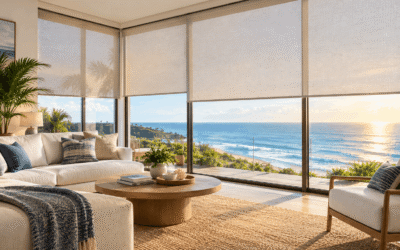
Living rooms and shared spaces. Light-filtering roller shades or faux wood blinds balance durability with a clean, modern look that photographs well and holds up to daily use without requiring the full blackout a bedroom needs.
Kitchens and bathrooms. Faux wood blinds or vinyl shades are the safest choice here, given the added moisture exposure. Avoid fabric shades in these rooms specifically, since staining and mildew risk are both meaningfully higher.
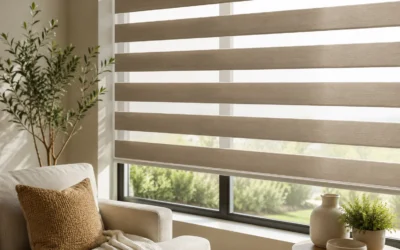
Rooms where guests want some self-adjustment. For living spaces where guests may want to fine-tune privacy without asking a host, zebra shades are worth considering. Their intuitive up-and-down adjustment between sheer and opaque bands is simple enough for a guest to figure out immediately, without the confusion a more specialized treatment might cause.
For Anything Beyond a Standard Shade, Add Instructions
If a unit includes anything beyond a simple cordless roller or blind, motorized shades, top-down bottom-up styles, or a panel track system, a short, clear instruction card near the window prevents the vast majority of guest confusion and the accidental damage that often follows it. A single sentence with a simple diagram is usually enough. This small addition is one of the most cost-effective ways to protect a more specialized (and more expensive) window treatment from being forced, jammed, or operated incorrectly by someone encountering it for the first time.
Coastal-Specific Considerations for Rental Properties
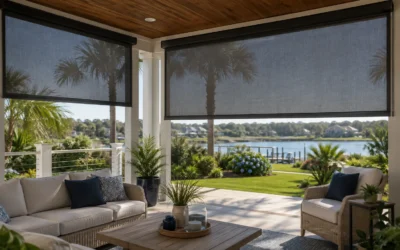
Gulf Coast rental properties deal with an added layer that inland rentals don’t: salt air and humidity accelerating wear on both fabric and hardware. This makes material choice even more important than it already is for a standard rental. Faux wood and vinyl resist humidity-related warping far better than real wood or delicate natural fibers, and metal hardware components should ideally be corrosion-resistant, particularly for units close to the water or with balcony and patio doors that see frequent airflow and moisture exposure.
For owners managing multiple coastal rental units, this is also a case where investing slightly more upfront in humidity-appropriate materials pays off faster than it would in a drier climate, since the gap between a good and a poor material choice shows up sooner in a coastal environment than it would inland.
Cleaning Between Turnovers
Low-maintenance doesn’t mean zero-maintenance, and a quick cleaning routine between guests keeps window treatments looking sharp far longer. Faux wood and vinyl blinds wipe down easily with a damp cloth, which fits naturally into a standard turnover cleaning checklist. Fabric roller and cellular shades benefit from a quick pass with a vacuum brush attachment to remove dust, with spot cleaning as needed for anything more visible. Building this into the same checklist used for the rest of the unit, rather than treating it as a separate task, is usually enough to keep treatments looking consistently presentable without adding meaningful time to a turnover.
Getting the Right Setup for Your Property
The specific combination of material, room-by-room treatment, and lift system that makes sense for one rental property doesn’t always translate directly to another, especially across a portfolio with different unit types, price points, and guest profiles. A quick consultation focused specifically on rental durability, rather than a standard residential recommendation, is the most reliable way to land on window treatments that hold up to guest turnover without sacrificing the polished, comfortable look that drives good reviews in the first place.