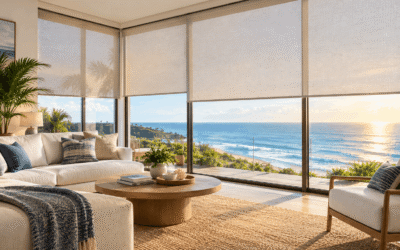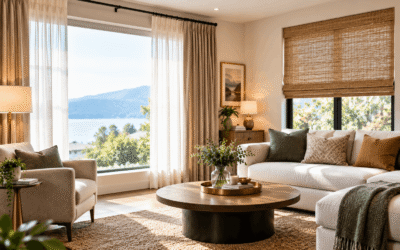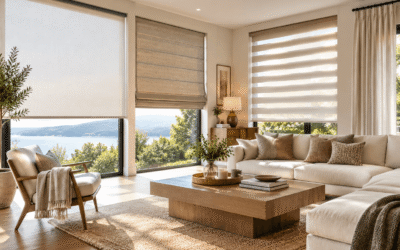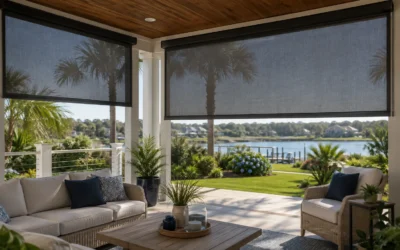
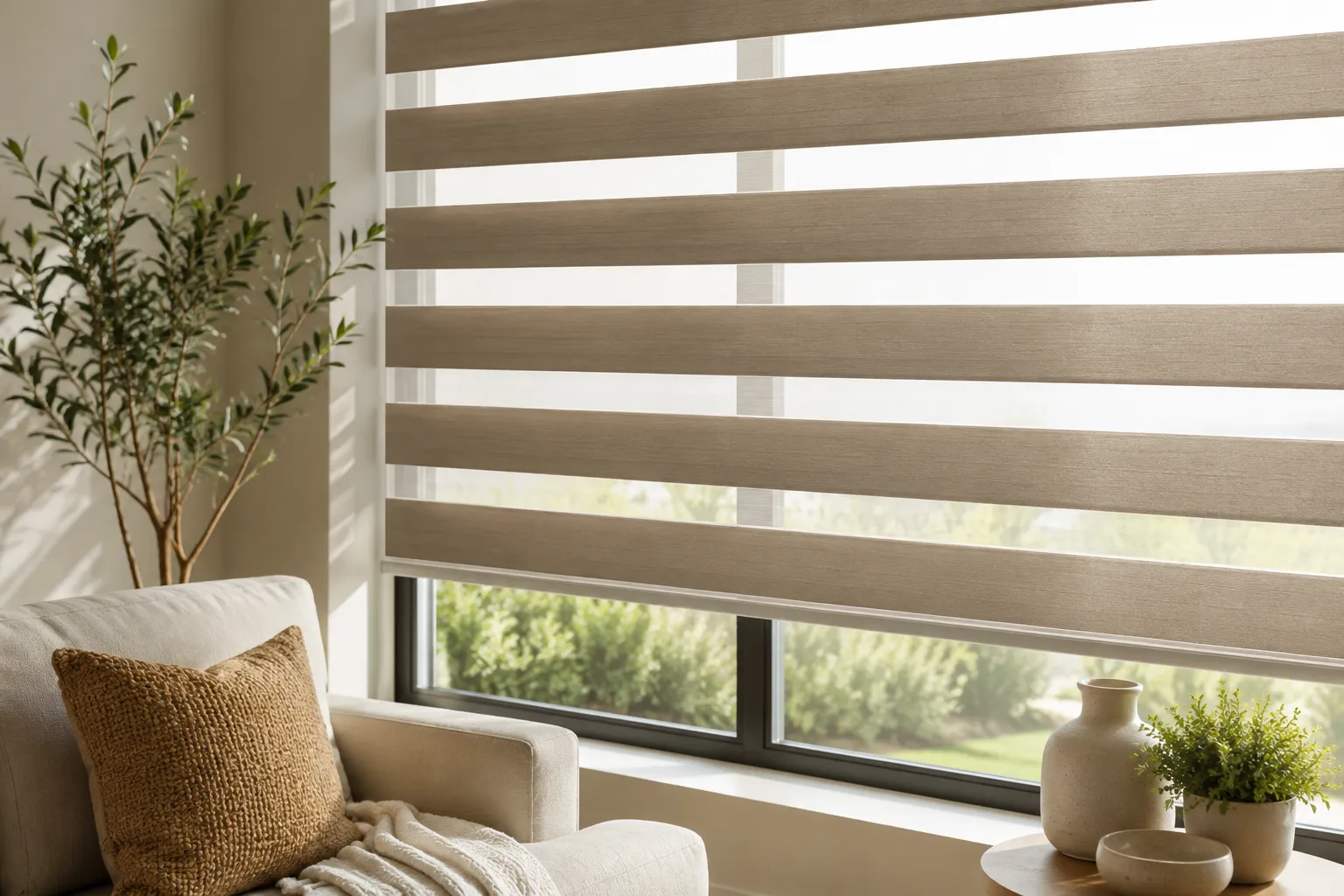
If you’ve seen the term “zebra shade” and wondered whether it’s actually different from a standard roller shade, or whether it’s just a design trend, here’s a full breakdown of how they work, where they perform best, and what to consider before choosing them for a Gulf Coast home.
What Zebra Shades Actually Are
Zebra shades, also known as dual shades, dual sheer shades, layered shades, or banded shades depending on the manufacturer, are built from a single continuous piece of fabric arranged into alternating horizontal bands: one sheer, one opaque, repeating down the length of the shade. The shade operates on two separate fabric layers stacked together, front and back, and it’s the relationship between those two layers that creates the effect.
The design might look decorative at first glance, but the stripes aren’t just visual. They’re the entire mechanism.
How the Light Control Actually Works
As you raise or lower a zebra shade, the front and back fabric layers shift relative to each other, which changes how the sheer and opaque bands line up.
When the sheer bands on both layers align with each other, light passes through both layers at once, filling the room with soft, diffused daylight while still offering a degree of outside visibility and some privacy, since you’re looking through two layers of sheer fabric rather than open glass.
When the shade is adjusted so the opaque bands on one layer overlap the sheer bands on the other, the opaque fabric blocks the gaps, and the shade functions much closer to a solid, light-blocking treatment, cutting most of the light and visibility through the window.
Because this adjustment happens continuously as the shade moves, you’re not choosing between two fixed states, you’re dialing in anywhere along a spectrum between fully open and fully private, all with the same pull, cord, or motorized command. This is the core appeal: one shade doing the job that would otherwise require pairing a sheer shade with a separate blackout or privacy layer.
Band Opacity: Light Filtering vs. Room Darkening
Not all zebra shades offer the same level of maximum privacy, and this comes down to the opacity of the solid band itself.
Light filtering bands keep the overall feel of the room bright and airy even in the most closed position, gently diffusing light rather than blocking it entirely. This works well for living rooms, dining areas, and kitchens where a soft, layered look matters more than total darkness.
Room darkening bands block a significantly higher percentage of light when the solid bands are aligned, which makes them the better choice for bedrooms, media rooms, or any space where you actually want the room to go dark, not just softened.
It’s worth being clear about one limitation here: even the most opaque zebra shade doesn’t typically achieve full blackout the way a dedicated blackout cellular shade does, since some light still passes at the seams between bands. For a primary bedroom where complete darkness matters for sleep, either choosing the darkest room-darkening option available or pairing the zebra shade with a separate blackout layer or drapery is the more reliable solution.
Color, Contrast, and Style
Beyond function, zebra shades offer more design flexibility than most people expect from what’s essentially a light-control mechanism.
Tonal color pairings, where the sheer and solid bands are close in shade, create a soft, subtle striped effect that reads as modern and understated. Higher-contrast pairings make the banded pattern much more visually prominent, turning the shade into more of a design statement than a background element. Neutral tones remain the most versatile choice for matching a range of interior styles, while bolder colors work well in a room where the window treatment is meant to stand out rather than blend in.
This flexibility is part of why zebra shades have become popular well beyond their functional appeal, they genuinely read as a contemporary design choice, not just a practical one, which is a rare combination in the window treatment world.
Where Zebra Shades Fit Best in a Coastal Home
Living rooms and family rooms. These spaces benefit most from the shade’s core advantage, staying bright and open during the day while offering an easy shift to more privacy in the evening without needing a second treatment layered on top.
Home offices. The ability to fine-tune light throughout the day, cutting glare on a screen without going fully dark, makes zebra shades a practical fit for work-from-home spaces with variable sun exposure.
Bedrooms, with the right expectations. Room-darkening zebra shades work well for bedrooms that don’t require total blackout, but homeowners who need complete darkness should plan to pair them with drapery or a dedicated blackout treatment rather than relying on the zebra shade alone.
Condos and rentals with close neighbors. Because zebra shades allow a gradual shift between filtered light and full privacy rather than an all-or-nothing choice, they’re well suited to units where sightlines from neighboring balconies or walkways are a daily concern rather than an occasional one.
Rooms to approach carefully: bathrooms, laundry rooms, and any space with frequent direct water exposure. Zebra shade fabric isn’t particularly well suited to high humidity or splashing, so if using one in these spaces, keep it well clear of the shower, tub, or sink.
Lift Options and Everyday Operation
Zebra shades are typically available with the same range of lift systems found across most modern shades. Cordless operation is the most common choice for its clean look and improved safety for homes with children or pets, since there’s no hanging cord to create a hazard. Motorized options add remote, smartphone, or voice control through a connected smart home system, which is particularly useful for wide windows, hard-to-reach installations, or homeowners who simply want the convenience of adjusting light and privacy without walking across the room.
Because the entire function of a zebra shade depends on precise alignment between its two fabric layers, motorized operation also has a practical advantage here beyond convenience: it removes any inconsistency in how evenly the bands line up, which can happen with manual adjustment over time as a shade gets used daily.
Maintenance and Durability
Zebra shades are generally low maintenance and hold up well with normal use. Because the fabric is flat and continuous rather than segmented into individual slats, they tend to collect noticeably less dust than traditional blinds, which makes routine cleaning simpler. A soft brush attachment on a vacuum, used every few weeks, along with occasional spot cleaning, is usually enough to keep a zebra shade looking sharp for years.
In a coastal climate specifically, the same general guidance that applies to other fabric shades applies here: keep them away from direct, sustained humidity exposure, and periodically check that the alignment mechanism is still moving smoothly, since salt air and humidity can occasionally affect hardware over long stretches of time if a home isn’t climate controlled consistently.
How Zebra Shades Compare to the Alternatives
Compared to traditional blinds, zebra shades offer a cleaner, more contemporary look without the visible slats, while still delivering meaningful light control flexibility, something a solid roller shade can’t match on its own. Compared to a plain roller shade, the dual-layer design gives zebra shades a genuine functional edge, letting you dial in a range of light levels rather than choosing between fully up or fully down. And compared to layering a separate sheer shade with a blackout shade, a zebra shade accomplishes a similar range of effects with a single mechanism and a single window treatment, which simplifies both the installation and the day-to-day operation.
None of this makes zebra shades the automatic right choice for every window. Rooms that need guaranteed full blackout, or spaces with regular high humidity, are usually better served by other products. But for the very common in-between need, a room that should feel bright and open most of the time but private and calm when it counts, zebra shades solve that specific problem better than almost anything else on the market right now.
Is a Zebra Shade Right for Your Home?
The best way to know whether a zebra shade makes sense for a specific room is to think through how that room actually gets used across a full day, not just how it looks in a single moment. A living room that needs to feel open in the morning and private by evening is a strong candidate. A bathroom near a shower probably isn’t. A bedroom that needs total blackout for sleep may need a zebra shade paired with something else rather than relying on it alone.
A free in-home consultation is the easiest way to work through these room-by-room decisions, including which band opacity, color, and lift system fits how you actually live in each space, so the shade you choose does exactly what you need it to do rather than just looking good on day one.
Getting the Right Combination for Your Home
There’s rarely a single “best” UV-resistant window treatment for an entire house. The right answer depends on how much sun each room gets, what’s inside it, and how much you’re willing to trade visibility or brightness for protection. A Gulf-facing living room with an expensive sectional and a water view calls for a very different solution than a home office with a desk and a bookshelf against an east-facing wall.
A free in-home consultation is the most reliable way to sort this out room by room, since it accounts for the direction each window faces, how many hours of direct sun it gets, and what’s actually at risk of fading inside. Getting the combination right the first time, rather than guessing and adjusting later, is usually the difference between a window treatment that quietly does its job for a decade and one that ends up needing an early replacement.